Offerings
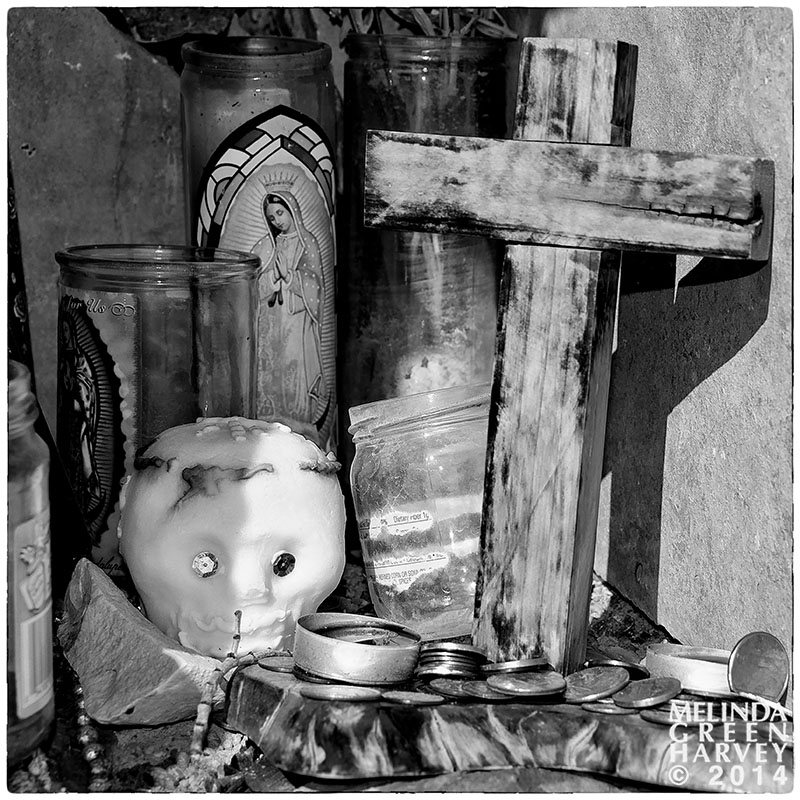
Today marks the beginning the Latin American celebration Día de Los Muertos, or Day of the Dead. It is a popular holiday in Mexico and is becoming increasingly popular in the American Southwest, too. (Here’s a good source of information on the tradition.)
Here in Lubbock, several art galleries participate in an event called Procesíon, with exhibits reflecting the cultural heritage and modern interpretations of the holiday. The Buddy Holly Center hosts workshops, and tomorrow my granddaughter and I are headed over to make sugar skulls, which is our traditional after-Halloween activity.
And, meanwhile, one winter day several months after the celebration, in a niche on the back of the cemetery gates in Terlingua, I spotted some relics of Day of the Dead.
Terlingua Cemetery
Terlingua, Texas
photographed 1.20.2013
(I am gone for a while, and will not be responding to comments right away. But make some anyway, if you feel inclined, and I’ll get back to you – it just won’t be right away.)
Posted on October 31, 2014, in Photography and tagged 365 photo project, black and white photography, cemetery, melinda green harvey, monochrome, NIK Silver Efex Pro 2, one day one image, photo a day, photography, terlingua, terlingua cemetery, terlingua texas, texas. Bookmark the permalink. 3 Comments.


In a tradition that must have gone back to Greco-Romans times my grandmother in the 50s used to set a table for the dead who came to visit between All Saints Nov. 1 and Nov. 2. She left a large terrine of boiled chestnuts and some cookies. During this week a cookie was also made from stiffly beaten egg white, much sugar and some flour, baked very hard and called The Bones of the Dead… they crackled as we bit into them. This was not in some backward village but in the industrial city of Torino.
LikeLike
Vera – what an interesting story. Thank you for sharing it with me.
LikeLike
The Ancient Greek and Romans believed that the dead had to be fed ritually and regularly, at small shrines in the home, or they would not be peaceful but might come back to haunt the family who forgot them. I just read it recently in a biography of Caesar Augustus. This habit/belief of my grandmother’s was not dictated by any Catholic usage or dogma. It was a tradition that had survived thru 2000 years of attempts by the Church to get rid of pagan rites !!! She feared ghosts and on that night she made sure to remain in her room so she would not run into any of her departed family visiting… ( even as child I was skeptical, but a little timorous too…).
LikeLike