Blog Archives
An announcement
I just received word that this photo – “In a ghost town, do ghosts go to church?” – was accepted into the Texas Photographic Society’s International Show!
It will be part of a 50-image exhibit at the Wittliff Galleries at Texas State University in San Marcos; that show will be up from June 1 through July 25. The show will then travel to the San Antonio Public Library during FotoSeptiembre and, later, to The Center for Contemporary Arts in Abilene.
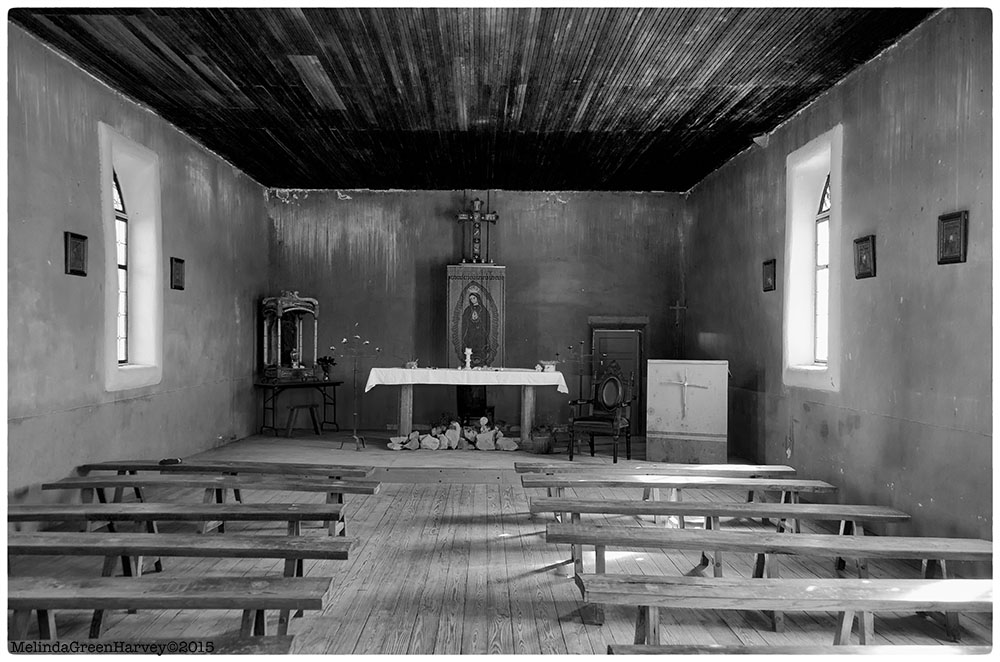
photographed in Terlingua, Texas, 1.20.2013.
I’d like to thank Brett Erickson for his good advice on this image, which I’ve entered (unsuccessfully) into several other competitions. He told me that I should keep submitting it because the “right” juror hadn’t seen it yet. Apparently, Dr. David Coleman, of Texas State University, was that “right” juror.
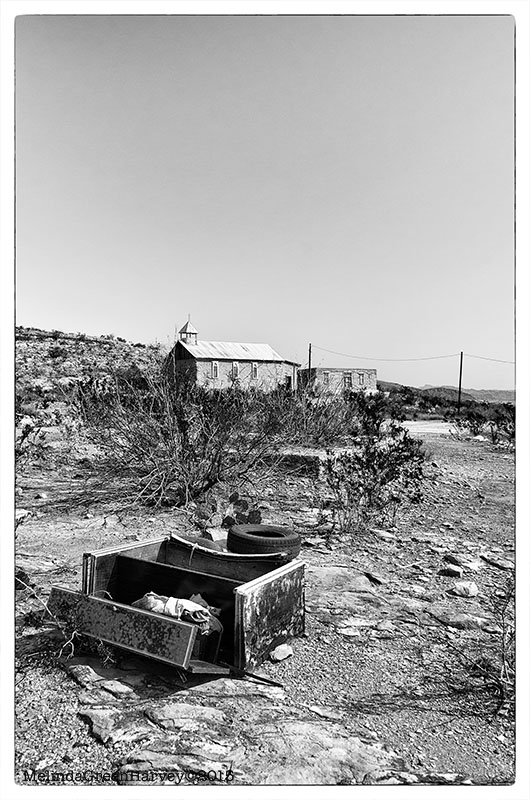
Offerings
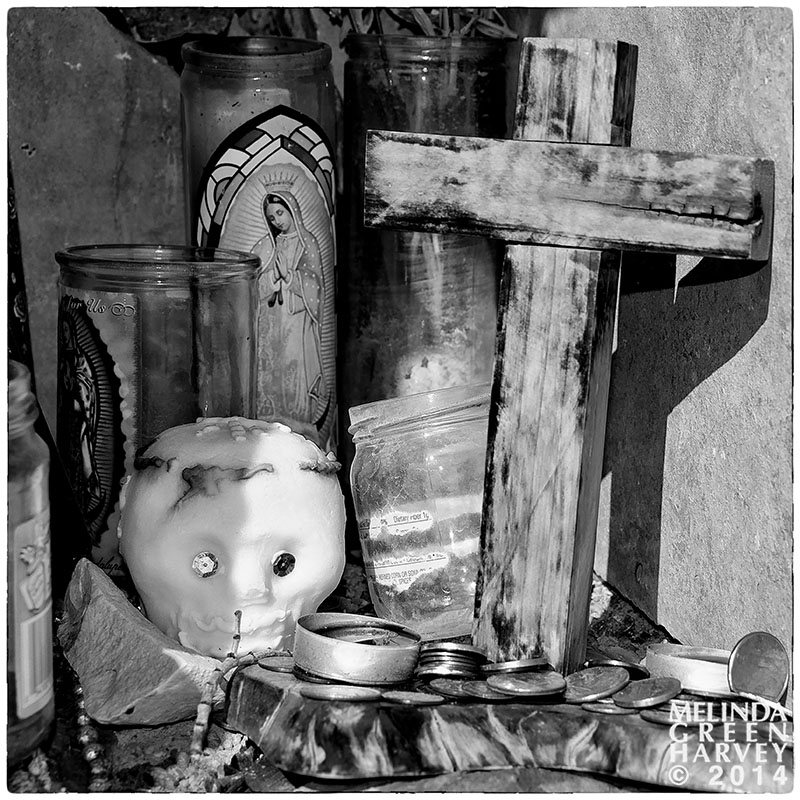
Today marks the beginning the Latin American celebration Día de Los Muertos, or Day of the Dead. It is a popular holiday in Mexico and is becoming increasingly popular in the American Southwest, too. (Here’s a good source of information on the tradition.)
Here in Lubbock, several art galleries participate in an event called Procesíon, with exhibits reflecting the cultural heritage and modern interpretations of the holiday. The Buddy Holly Center hosts workshops, and tomorrow my granddaughter and I are headed over to make sugar skulls, which is our traditional after-Halloween activity.
And, meanwhile, one winter day several months after the celebration, in a niche on the back of the cemetery gates in Terlingua, I spotted some relics of Day of the Dead.
Terlingua Cemetery
Terlingua, Texas
photographed 1.20.2013
(I am gone for a while, and will not be responding to comments right away. But make some anyway, if you feel inclined, and I’ll get back to you – it just won’t be right away.)
There are many mysteries
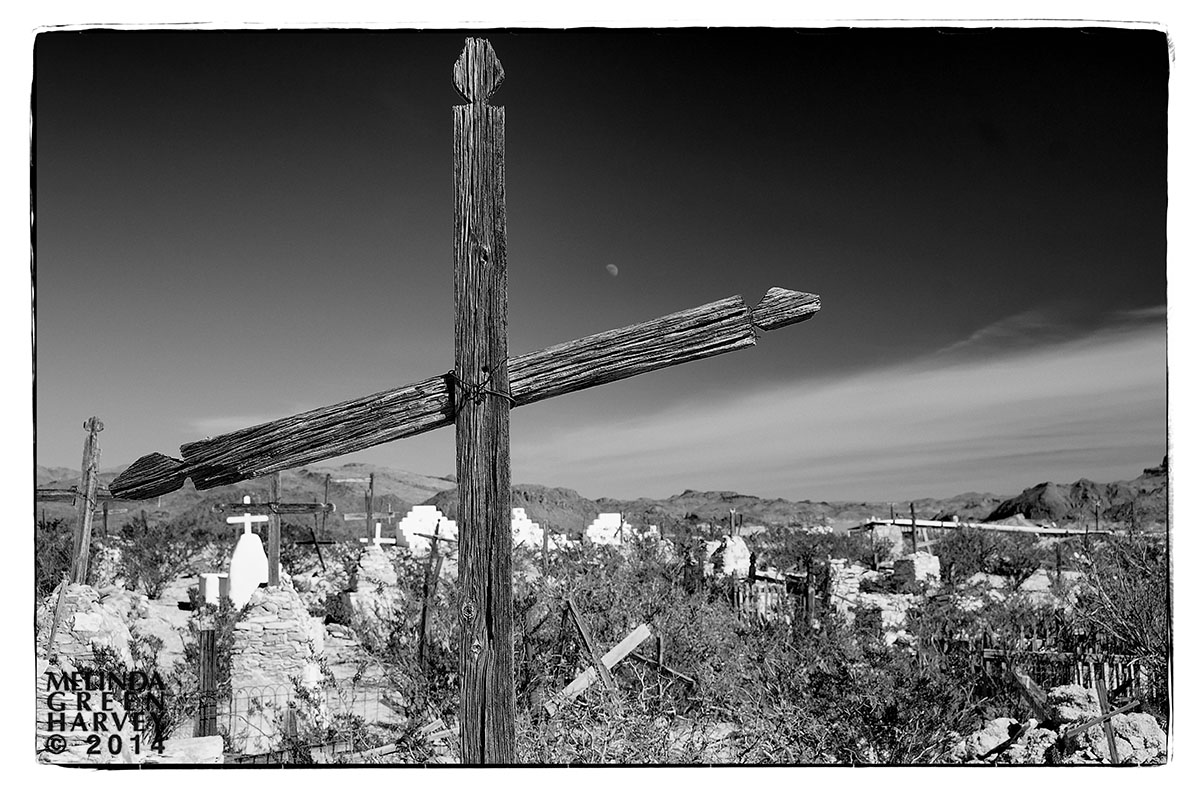
This cemetery is especially stark, with that jumble of mostly unmarked wooden crosses and piles of rock marking gravesites. It’s hot – so hot that candles melt, leaving greasy marks on the rocks. Many of the graves are those of miners, who succumbed to the occupational hazards in nearby mercury mines, which began production in 1903. Other graves are from the influenza epidemic of 1918-19. And still others are recent. They are crowded together (the complete site is only about an acre) and it’s easy to get scratches from mesquite trees or poked by cactus thorns.
But it is also especially beautiful, with a view across to the Chisos Mountains and Big Bend National Park and that half moon, one week away from the first full moon of the year, hanging in the sky.
Terlingua Cemetery
Terlingua, Texas
photographed 1.20.2013
(I am gone for a while, and will not be responding to comments right away. But make some anyway, if you feel inclined, and I’ll get back to you – it just won’t be right away.)
The dregs of dreams, 3
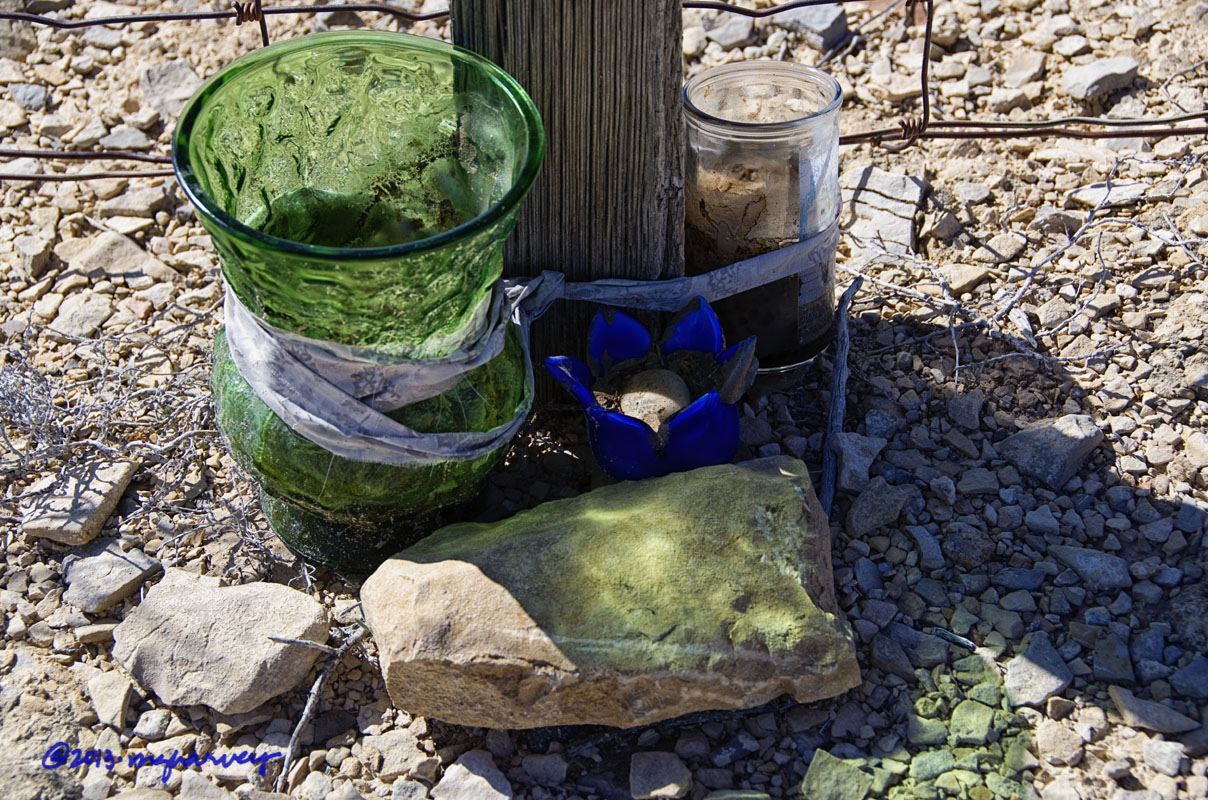
Weathered wooden cross stuck in hard ground, sad offerings beneath them.
Most of the graves are unmarked. Many of the dead buried here were victims of accidents in the nearby mercury mines, which were active in the early 1900s. Others were victims of the 1918-1919 flu epidemic.
Many of the graves have offerings – a vase, a candle, a flag, a letter, a handful of coins – which only amplify the mysteries.
Terlingua, Texas
photographed 1.20.2013


 One Day | One Image