Category Archives: architecture
The edge of Earth

My cousins lived in Earth, so you can only imagine that they heard every single ridiculous joke about their town’s name. At our house, when it was time to go up there for a visit, my dad would say we were “going to Earth.” It never got old. (Although it probably should have, at some point!)
These days there’s not much left in Earth. My cousins all moved away, and I can assume that most of their classmates did, too. There’s just not much going on around Earth these days. The Dairy Queen is closed, and so is this service station, out on the edge of Earth, along the highway to Springlake.
It’s not a new story.
Earth, Texas
photographed 5.24.2013
One detail spoiled everything

You knew this: that I almost never take photos of new buildings. I like old ones better.
But, when you are walking around downtown Dallas with your friend (we’ll call him “Carlos” but only because that’s his name), there’s a lot more new stuff to look at than anything else.
This place, then. I am very fond of the glass blocks, lined up like huge ice cubes. I like the way the light reflects off the column on the right into the window, making a lighter rectangle on top of everything. I like the long shadow, the way it angles down, goes straight across the wall, and then angles down again; that’s a very nice shadow line.
But what I saw when I took the picture and can’t bring myself to un-see is that duplex outlet, right there in plain sight. Why, architect of this building, did you let that happen? I want to believe that you knew how that reflected light would work, how the shadow’s angles would be so appealing, that you’d thought about all of it and made very sound design decisions. But a wall outlet? That was the very best place to put an outlet? You’re sure, architect of this building?
Dallas, Texas
photographed 3.19.2011
A two bulb fixture

Corrugated metal. Weathered wood. An sun-lit weed. Conduit nestled into the valleys of the metal. A peeling sign. A partially-boarded window.
And presiding over it all – a two bulb fixture. (To be correct, I guess it’s a ZERO bulb fixture, but you know what I mean.)
Santa Rosa, New Mexico
photographed 9.21.2013
My dilemma
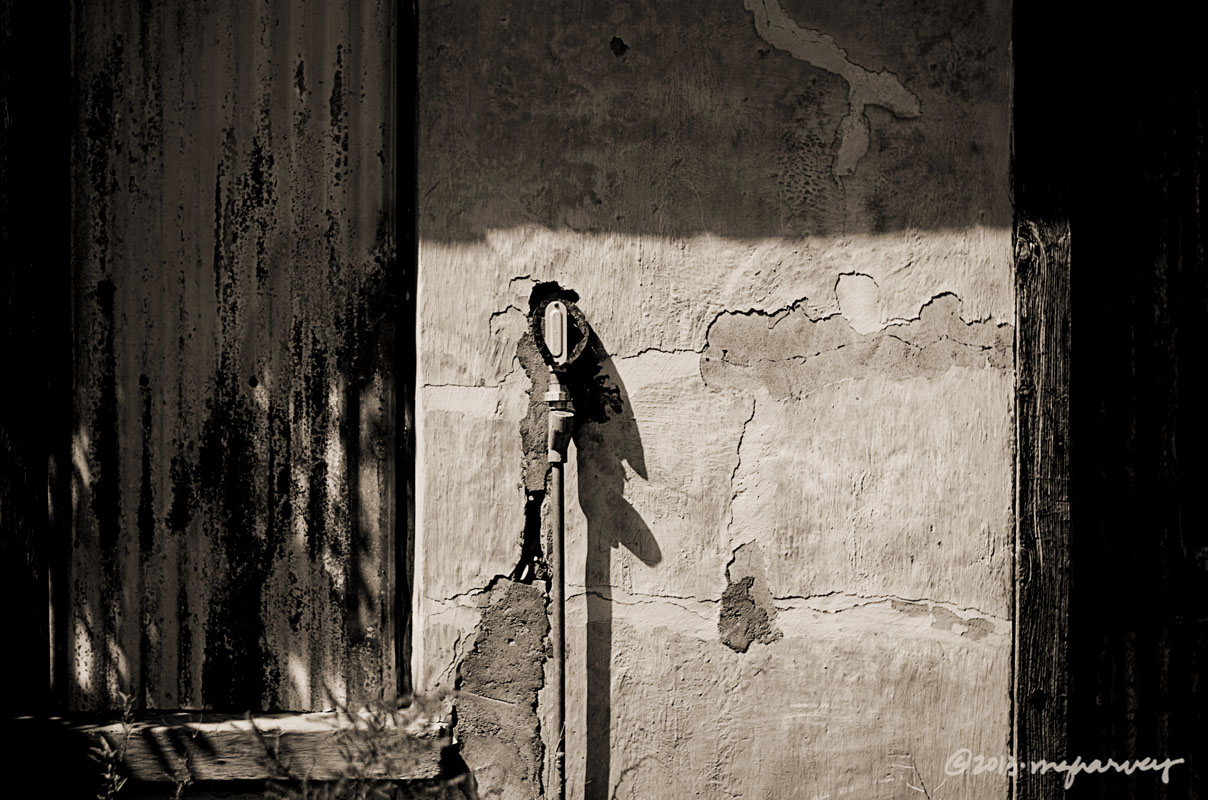
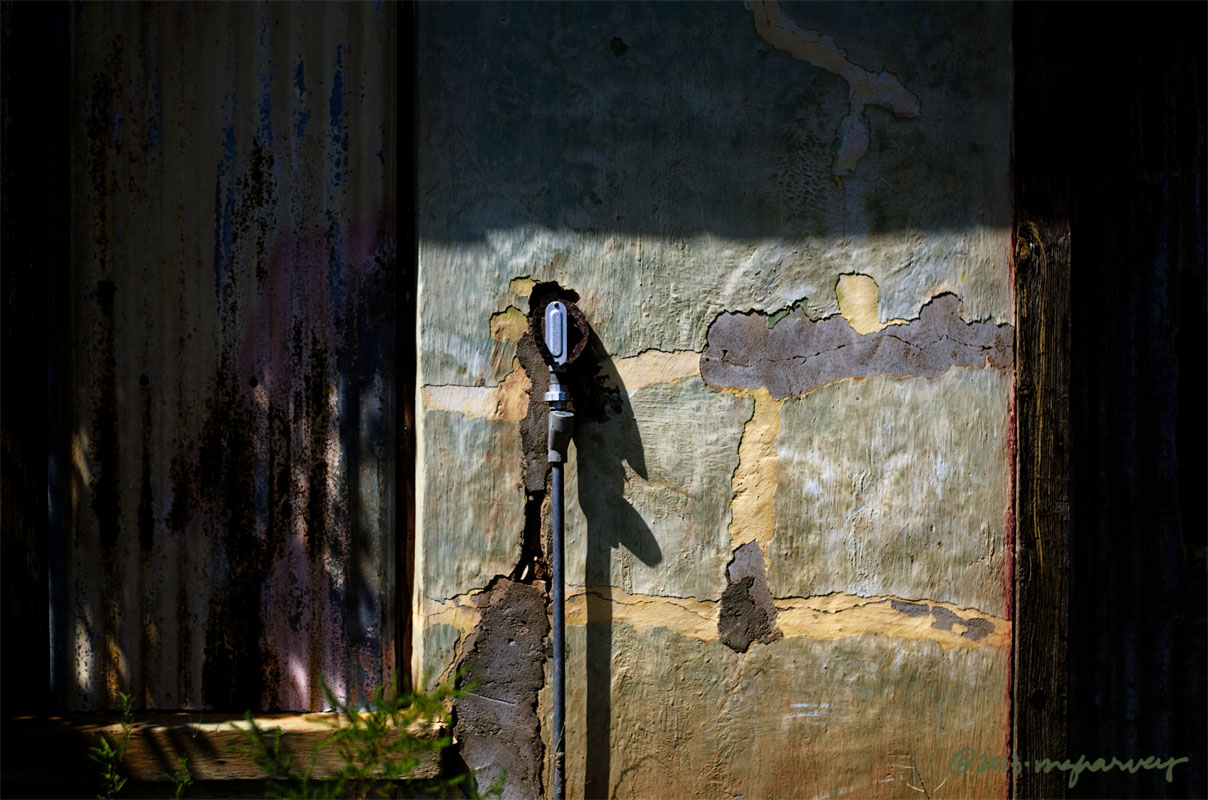
Usually, I don’t even think about it – I just know that whatever I am posting is going to be in black and white. Every now and then, though, a photo will demand to be in color, so that’s the way I post it.
This one, though, has been difficult to reason with. It wants it both ways, and honestly, I see its point. The color one is nice, with the lavender and cream and green and blue. But the other one’s got texture everywhere. I can’t decide.
Opinions/comments/votes are welcome.
Puerto de Luna, New Mexico
photographed 9.21.2013
It’s hard to tell who won the war
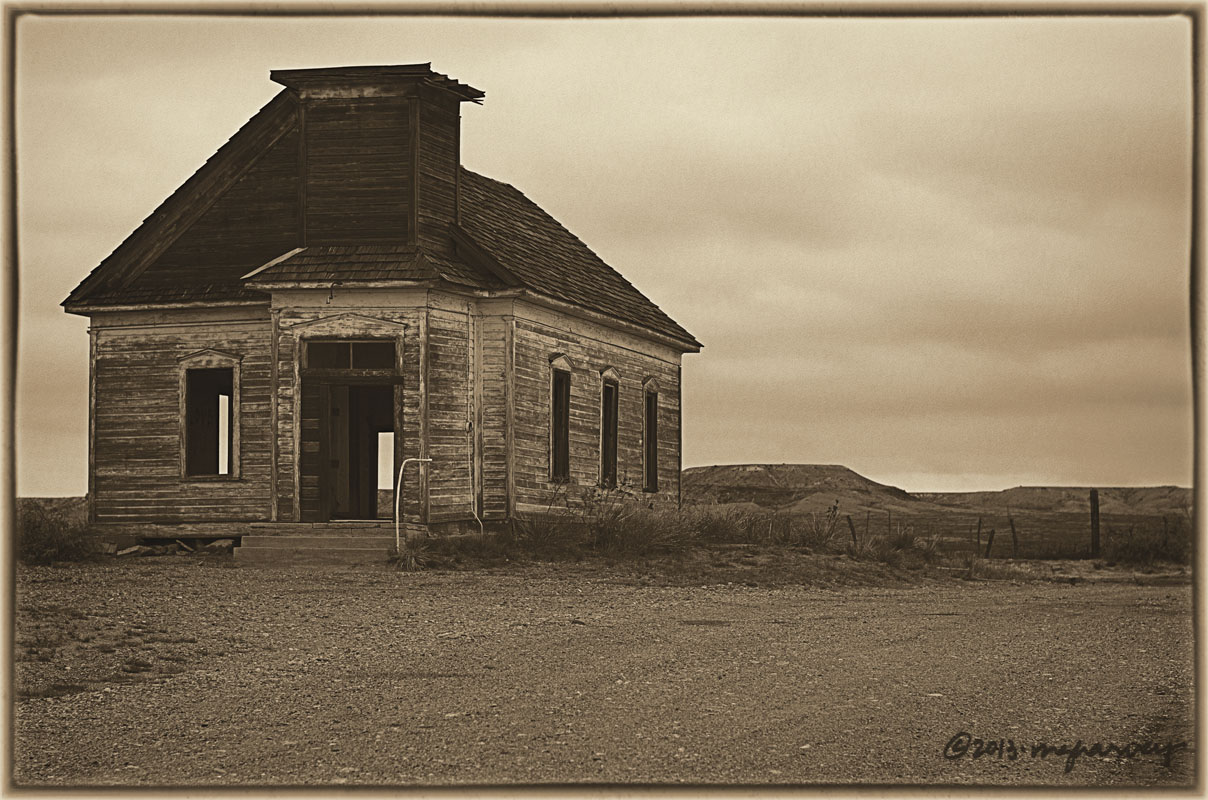
The First Presbyterian Church in Taiban was built in 1908 for $250, over half of which came from loans from “the ladies of the Baptist church and the Taiban Savings Bank.”* Hopes must have been high in Taiban back then: the railroad was there, newly relocated from a more northern route. There was a bank, a hotel, a school, and a contract to build 50 homes. There were already over 400 residents.
But then, trouble arrived, in the form of the Pink Pony Saloon and Dancehall. The town was broken into factions; periodic elections made alcohol legal one time, then illegal another, back and forth all the way into the 1930s. By that time, the effects of a long drought and the Depression, as well as the ongoing alcohol wars, took their toll, and the Presbyterian church held its final service in 1936.
After World War II, there were only about fifty residents. But with the church closed down, it looked as though alcohol had won: bars were the tiny town’s only successful businesses. People from surrounding dry counties in eastern New Mexico and the Texas panhandle would travel to Taiban when they felt a need to quench a certain thirst; the wealthiest patrons would fly in, landing at what became known as the Taiban International Airport.
But life was hard, dry-land farming harder. Passenger train service was gone, and the roads were necessarily hospitable. By the 1960s, only one business – a bar – remained in town.
Today, the bar’s gone.
But photographers take the time to pull off the road (which is more hospitable now) to take pictures of what’s left of the First Presbyterian Church. Somewhere along the line, concrete steps and a handrail were added to make for easier access. There’s graffiti now, on the walls – prayers and Bible verses and a sketch of Jesus with outstretched arms as if to say, “Write on these walls, my children.”
Taiban, New Mexico
photographed 9.20.2013


 One Day | One Image