Blog Archives
bois d’arc series #2: not mutant tennis balls

From the highway, the fallen fruit looked a bit like mutant tennis balls…
The fruit, the largest of any species native to North America, is hard and carries an unpleasant odor (although the day I made these images, the wind was pretty strong and I guess the stink blew away before I noticed it.) With the exception of squirrels, no native animal will eat them.
The trees and the fruit both ooze a sticky white sap. So probably these trees aren’t a good landscaping choice.
Hockley County, Texas
photographed 1.13.2024
bois d’arc series #1: “welcome”

I’m sort of right in the middle of an inadvertent series of botanical images. Somethings things just line up on their own…
Anyway, out on the highway between Levelland* and Whiteface* there’s a picnic area with a mile-long row of bois d’arc trees behind it. As far as I know, these are the only bois d’arc trees I’ve ever seen, but I’d read about them in the book PrairyErth: a deep map (William Least Heat-Moon) and recognized them from the description stored in my head.
Prior to the introduction of barbed wire, bois d’arcs were in common use along fencerows. As barbed wire become more common, this particular use of the tree declined. The Dust Bowl caused a resurgence in their use: beginning in 1934, the Works Progress Administration planted over 200 million trees on farmland to serve as windbreaks to prevent soil loss. My guess is that this particular row of trees was planted during that era.
The (inedible) fruit from these trees has several names, including Osage orange, horse apple, and hedge apple. The vernacular pronunciation is “bodark.”
Hockley County, Texas
photographed 1.13.2024
*Actual town names.
eight days

When the Christmas-table flowers were eight days old some of the flowers were dead and lying on the table, which of course called for a photo.
Lubbock, Texas
photographed 1.1.2024
arcs (with spikes)
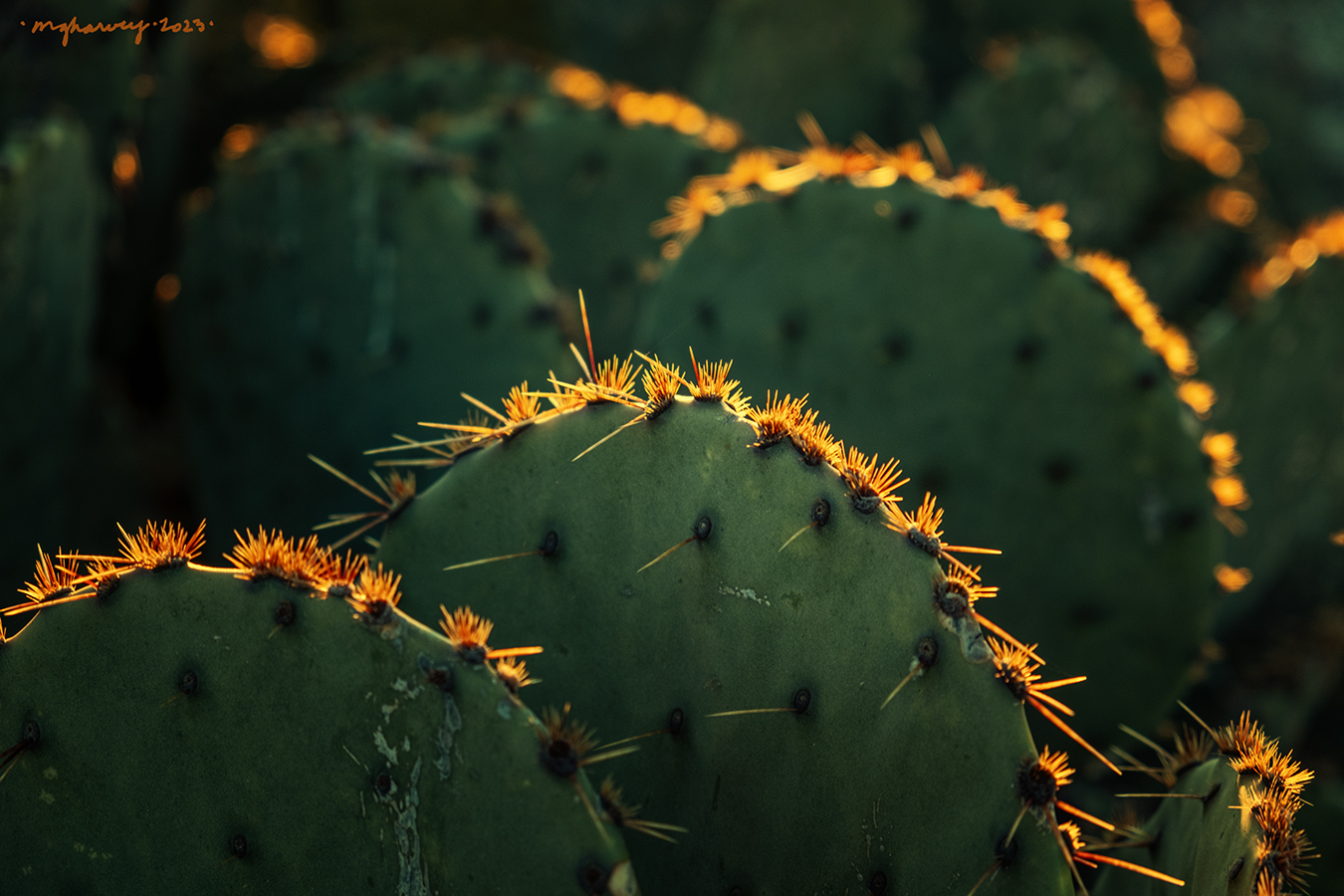
I mean, sure, these are pretty. The spiky arcs (and the way they repeat themselves.) The golden light. The contrast with the green.
But don’t be fooled: those things will stab you without a second thought.
(Reasons to Use a Zoom Lens, lesson one)
Yellowhouse Canyon, Texas
photographed 12.17.2023


 One Day | One Image