Blog Archives
It’s hard to tell who won the war
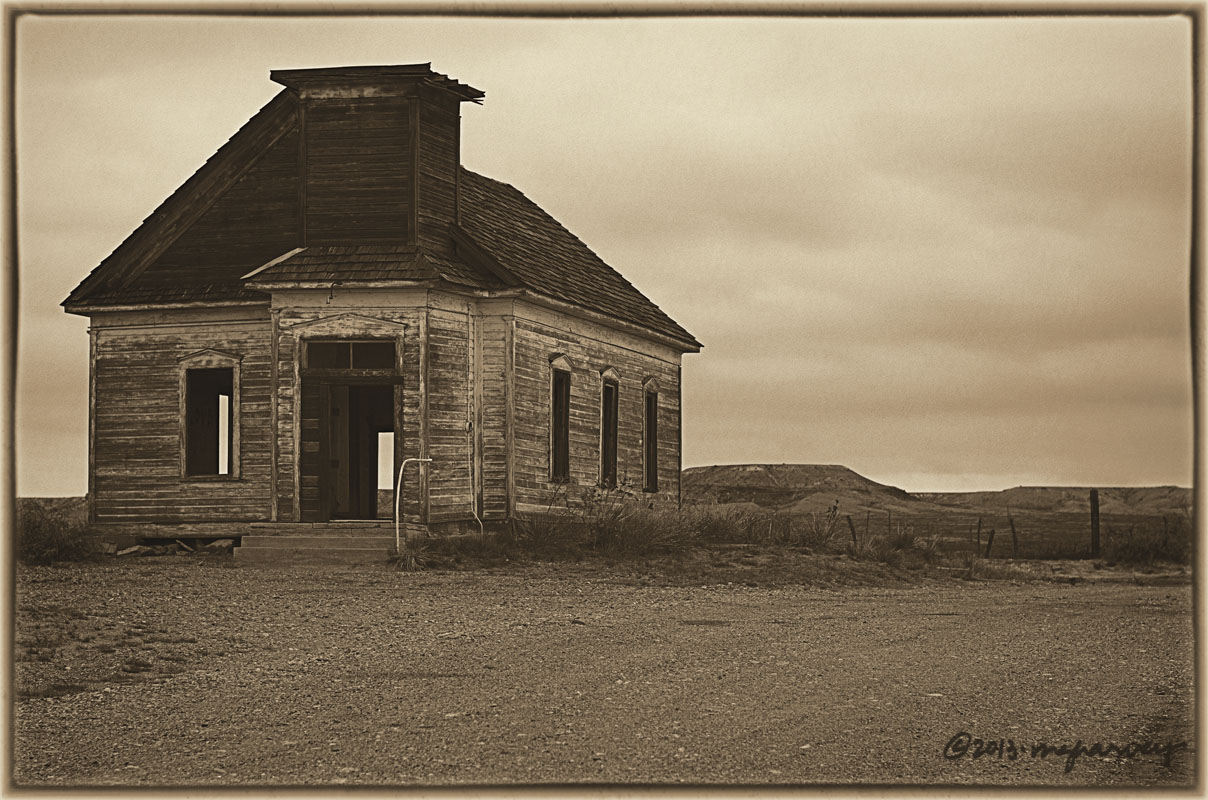
The First Presbyterian Church in Taiban was built in 1908 for $250, over half of which came from loans from “the ladies of the Baptist church and the Taiban Savings Bank.”* Hopes must have been high in Taiban back then: the railroad was there, newly relocated from a more northern route. There was a bank, a hotel, a school, and a contract to build 50 homes. There were already over 400 residents.
But then, trouble arrived, in the form of the Pink Pony Saloon and Dancehall. The town was broken into factions; periodic elections made alcohol legal one time, then illegal another, back and forth all the way into the 1930s. By that time, the effects of a long drought and the Depression, as well as the ongoing alcohol wars, took their toll, and the Presbyterian church held its final service in 1936.
After World War II, there were only about fifty residents. But with the church closed down, it looked as though alcohol had won: bars were the tiny town’s only successful businesses. People from surrounding dry counties in eastern New Mexico and the Texas panhandle would travel to Taiban when they felt a need to quench a certain thirst; the wealthiest patrons would fly in, landing at what became known as the Taiban International Airport.
But life was hard, dry-land farming harder. Passenger train service was gone, and the roads were necessarily hospitable. By the 1960s, only one business – a bar – remained in town.
Today, the bar’s gone.
But photographers take the time to pull off the road (which is more hospitable now) to take pictures of what’s left of the First Presbyterian Church. Somewhere along the line, concrete steps and a handrail were added to make for easier access. There’s graffiti now, on the walls – prayers and Bible verses and a sketch of Jesus with outstretched arms as if to say, “Write on these walls, my children.”
Taiban, New Mexico
photographed 9.20.2013
Gateway of the moon

On a day that almost felt like fall, an obliging cloud approached the cross atop Nuestra Señora de Refugio church.
Now a virtual ghost town, the village of Puerto de Luna was once a thriving community. In fact, according to New Mexico’s Best Ghost Towns: A Practical Guide, in the 1890s, Puerto de Luna was the only town in the southeast quadrant of the state with a population greater than 500 people. But the railroad went through Santa Rosa, ten miles away, and later so did Route 66. Progress was not a friend to this place.
According to the same book, there’s some disagreement over the meaning of the town’s name. One faction believes it was named for the Luna family, and translates into English as Luna’s Gap. The other faction believes it translates into Gateway of the Moon, after a gap in the nearby mountains through which the moon sometimes rises. You know which translation I prefer.
Puerto de Luna, New Mexico
photographed 9.21.2013
Rose of Lima

This is part of what’s left of the old church at the St. Rose of Lima cemetery; a marker just inside the fence says the cemetery was established in the early 1800s, and was “replaced to its current location” in 1907. I don’t know how long the church has been without a roof. Or a floor. Or windows. But it’s still standing, maybe out of habit as much as anything else.
This is another example of the way a building can eventually devolve into just its textures – and this one’s got plenty of textures, with the weather-rough wood, the initialed plaster, the stones.
And it even has a flower, tucked into a break in the plaster underneath the window.
Santa Rosa, New Mexico
photographed 9.21.2013
Duplex

Meanwhile, back in Santa Rosa, New Mexico, this place slowly falls apart.
It’s got a lot of company: there are many buildings in town that have seen better days. But you know me: I love places like this. I like the way they fall apart, the way someone tries – without success – to stop the decay, the way even the patched parts start to fall apart, too. I love the textures of the different building materials. And the way the weeds grow up, seeming to guard whatever’s still inside.
And, I love the mystery of the two front doors.
(My weekend was a WordPress weekend. I met up with blogger Donna Catterick in Santa Rosa and we spent Saturday and part of Sunday taking pictures. And, also had a couple of great phone conversations with Ehpem and Brett Erickson. What a weird thing, blogging!)
Santa Rosa, New Mexico
photographed 9.21.2013
Sometimes I go to the city

I can understand why anyone who stops by here on a regular basis might think the largest town I’ve ever been to is Muleshoe, Texas (population 5,217), but I have actually gone to some larger towns. Like Brownfield – population 9,675. Or Levelland – population 13,517. Or Sweetwater – population 10,447.
And this one time? I went to Dallas.
downtown Dallas
photographed 3.19.2011
Full disclosure #1: If you think I chose the town examples because their names are funny and/or descriptive, you are correct.
Full disclosure #2: I’ve actually been to Dallas more than just the one time.


